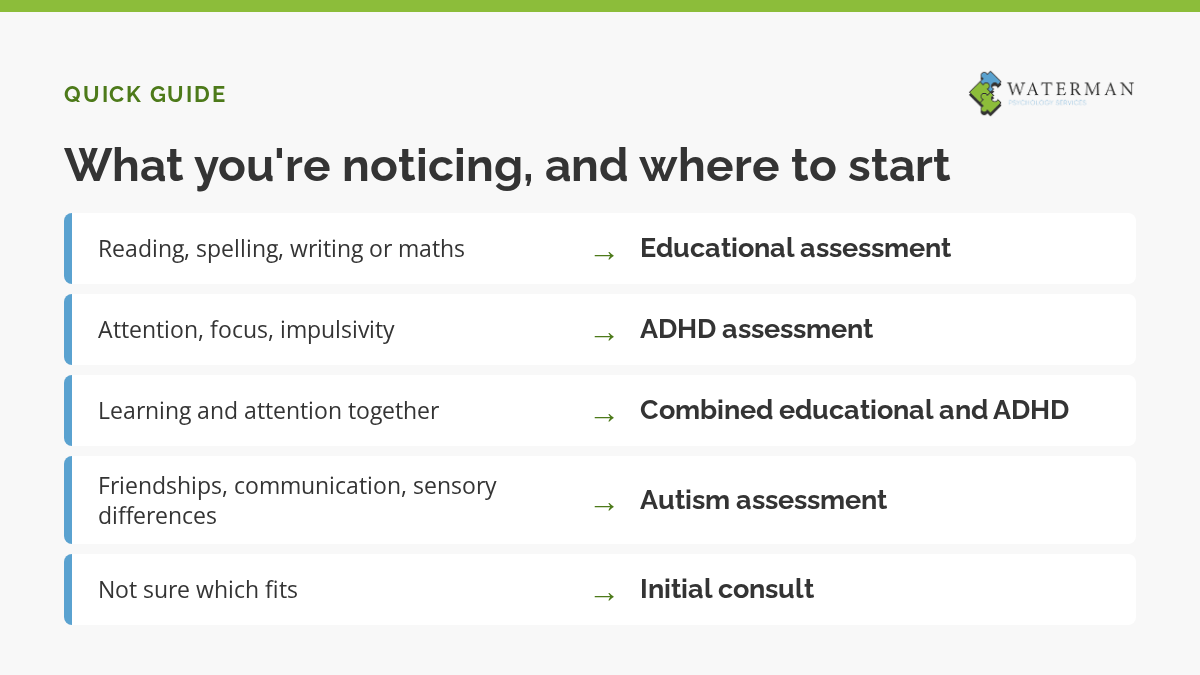
It depends on what you and the school are seeing. Trouble with reading, spelling, writing or maths usually points to an educational assessment. Trouble with attention, focus or impulsivity points to an ADHD assessment. Differences in social communication point to an autism assessment. When concerns overlap, a combined assessment or a short initial consult can help you decide.
Many parents call us after the school has suggested an assessment without saying which one. If that’s you, this guide walks through what each assessment looks at, how long it takes and what it costs, so you can choose with a clearer picture.
If the school has said “get an assessment” and not much else
Start with what you’ve noticed and what the teacher has told you. Write the concerns down in plain words, such as “reads slowly” or “can’t stay on task”, and gather any reports from health professionals from the last two years. Those notes are usually enough to point to the right assessment, or to a short conversation about it.
It helps to ask the teacher three questions:
- Is the concern mainly about reading, writing or maths?
- Is it about attention, getting started or finishing work?
- Is it about friendships, communication or coping with change?
You don’t need to bring every school report. Reports from psychologists, speech pathologists, occupational therapists or paediatricians from about the last two years are the useful ones. If we need anything from the school, we’ll ask.
Educational assessment: for reading, writing and maths concerns
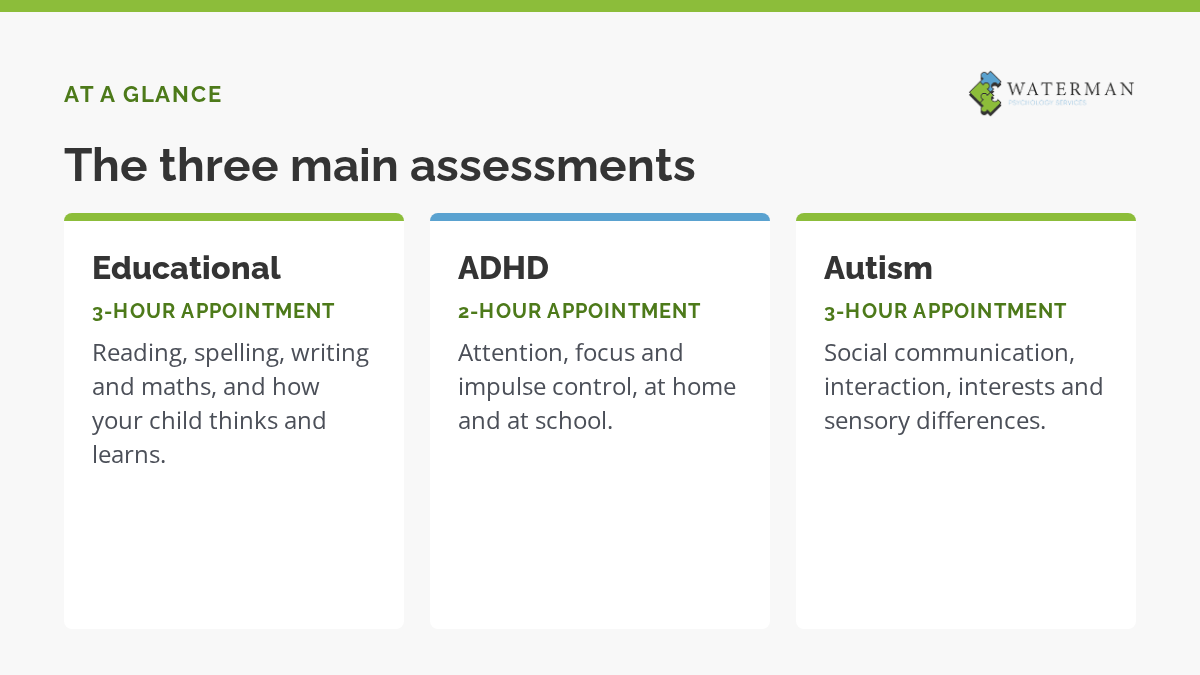
An educational assessment looks at how your child thinks and learns, and how their reading, spelling, writing and maths compare with others their age. It’s the assessment used to identify a specific learning disorder, such as dyslexia (reading), dysgraphia (writing) or dyscalculia (maths), and to understand your child’s learning strengths as well as their difficulties.
It may be the right starting point if your child:
- reads well below their classmates, or avoids reading aloud
- has spelling that doesn’t stick, even after practice
- struggles to remember maths facts or follow number steps
- has written work that is much weaker than the ideas they can explain out loud.
At Waterman Psychology, a child educational assessment is one 3-hour appointment for children aged 6 to 17. The fee is $1,595. Adults can have an educational assessment too ($1,700). If reading is the main worry, our article on how dyslexia is tested goes into more detail.
ADHD assessment: for attention, focus and impulsivity concerns
An ADHD assessment looks at whether difficulties with attention, activity and impulse control fit the criteria for ADHD, and how they affect your child at home and at school. It draws on your input, standardised questionnaires and a cognitive assessment, so recommendations can be matched to how your child learns.
It may be the right starting point if your child:
- drifts off during instructions, at home and at school
- starts tasks but rarely finishes them
- loses things often, or forgets steps in routines
- acts or speaks before thinking, more than others their age.
A child ADHD assessment is a 2-hour appointment and costs $1,395. Adult ADHD assessments are the same fee. Both can be booked online. We don’t prescribe medication. If medication is something you want to explore after the assessment, that’s a conversation with your paediatrician or GP. Wondering about the cost? Read how much an ADHD assessment costs.
Autism assessment: for social communication concerns
An autism assessment looks at social communication, interaction, play, interests and sensory differences, and whether they fit the criteria for autism spectrum disorder. It uses structured observation and standardised tools alongside a detailed developmental history from you. At Waterman Psychology Services, autism assessments start with a phone call to check an assessment is the right next step.
It may be the right starting point if your child:
- finds friendships hard to make or keep
- has very strong, focused interests
- reacts strongly to change, noise, textures or other sensory input
- relies heavily on routines and finds it hard when they change.
An autism assessment is one 3-hour appointment for ages 6 and up, and costs $1,795. To book, call us on 08 8133 5711. The written report usually takes about 2 weeks.
Learning difficulty or ADHD? Why it’s often hard to tell
In a classroom, a learning difficulty and ADHD can look alike. A child who can’t read the instructions may look like they’re not paying attention. A child with ADHD may miss parts of a lesson and fall behind in reading or maths. The two can also occur together, which is why some families choose a combined assessment.
Attention difficulties can have several causes, including anxiety, poor sleep, language difficulties and learning difficulties. Australia’s clinical practice guideline for ADHD recommends that assessment considers other conditions and co-occurring difficulties, rather than looking at ADHD alone (Australian ADHD Professionals Association, 2022). In practice, that means a good assessment starts with the question, not the answer.
| What you’re mainly noticing | Usual starting point |
|---|---|
| Reading, spelling, writing or maths | Educational assessment |
| Attention, focus, impulsivity, finishing work | ADHD assessment |
| Both learning and attention | Combined educational and ADHD assessment |
| Friendships, communication, routines, sensory differences | Autism assessment |
| Social communication and attention | Combined autism and ADHD assessment |
| Not sure | Initial consult ($300) |
When a combined assessment makes sense
If the school has raised both learning and attention concerns, a combined assessment covers both questions in one booking. Waterman offers a combined educational and ADHD assessment for children ($1,795, one 3-hour appointment) and for adults ($1,900), and a combined autism and ADHD assessment ($2,095).
These are our standard fees, listed with every other fee on our fees page.
What if the assessment points to something else?
Sometimes an assessment booked for one question points to another. If that happens, the psychologist will explain what they’re seeing and talk with you about whether to look into it, and will only go ahead with your consent. You’re investing time and money, so the aim is to answer the real question, not just the one on the booking. If looking into a different question would change the fee, we’ll always discuss this with you first. We’ll also tell you clearly if your child doesn’t meet the criteria for a diagnosis, and explain what we think is going on instead.
Still not sure? Book an initial consult
If you can’t tell which assessment fits, a 1-hour initial consult with a psychologist can help you decide. It costs $300 and is separate from any assessment fee, so nothing comes off the assessment if you go ahead. If your concerns clearly fit one of the assessments above, you can book that assessment directly.
Questions parents often ask
Can my child be assessed if they’re under 6?
We assess children from age 6 to 17. If your child is under 6, we suggest talking with your GP or a paediatrician first. We also assess adults.
Do you offer therapy?
No. Waterman Psychology only does assessments. If your child would benefit from therapy or other support afterwards, the report sets out recommendations you can take to your GP, your child’s school or other health professionals.
How long is the wait?
The current wait for an assessment is about 4 weeks.
Does Medicare cover these assessments?
Medicare doesn’t cover educational or ADHD assessments. A Medicare rebate may be available for autism assessments for people under 25 with a referral. Private health may cover some assessments, so check with your health fund. Medicare and private health can’t both be used for the same assessment.
What should we bring?
Reports from health professionals from about the last two years, such as psychologists, speech pathologists, occupational therapists or paediatricians. You don’t need every school report. If we need anything from the school, we’ll ask.
Booking an assessment at Waterman Psychology
Every assessment at Waterman Psychology is completed by a fully registered psychologist, and every report is written by the psychologist, not AI. We’re at 188 Glen Osmond Rd, Fullarton, open Monday to Friday, 10am to 5pm. You can book online (educational and ADHD assessments) or call 08 8133 5711. All current fees are on our fees page.
If you or your child need urgent support, call 000, Lifeline on 13 11 14 or Kids Helpline on 1800 55 1800.
Reviewed by Michael Waterman, Registered Psychologist (MAPS), with over 17 years’ experience as a psychologist. AHPRA registration PSY0001318442. Last reviewed: 28/10/26
Sources
- Australian ADHD Professionals Association (2022). Australian Evidence-Based Clinical Practice Guideline for Attention Deficit Hyperactivity Disorder (ADHD). Melbourne: AADPA. adhdguideline.aadpa.com.au
- American Psychiatric Association (2022). Diagnostic and Statistical Manual of Mental Disorders, Fifth Edition, Text Revision (DSM-5-TR).
Related reading: How much does an ADHD assessment cost? · How do you test for dyslexia?