Dyslexia is identified through a psychological assessment, usually called an educational assessment. A registered psychologist compares your child’s reading, spelling and related skills with others their age, assesses how they think and learn, and reviews their history and the support they’ve had. Online quizzes and school screeners can flag a concern, but they can’t diagnose dyslexia.
What is dyslexia, in clinical terms?
Dyslexia is a learning difficulty that mainly affects reading accuracy, reading speed and spelling. In the DSM-5-TR, the manual psychologists use for diagnosis, it falls under “specific learning disorder with impairment in reading”. The manual recognises “dyslexia” as another name for this pattern of difficulties (American Psychiatric Association, 2022).
Dyslexia isn’t a sign of low intelligence, and it isn’t a vision problem.
Who can diagnose dyslexia?
In Australia, a diagnosis of specific learning disorder, including dyslexia, is usually made by a psychologist after a full assessment. Teachers, tutors and speech pathologists often notice reading difficulties first and play a big part in support. A formal diagnosis needs standardised testing, interpreted against the diagnostic criteria.
What happens in a dyslexia assessment?
At Waterman Psychology Services, testing for dyslexia is part of an educational assessment: one 3-hour appointment for children aged 6 to 17. It includes a short consult with you, about 2 hours of testing with your child (with a 20-minute break) and brief feedback at the end. A written report follows within about 5 to 10 business days.
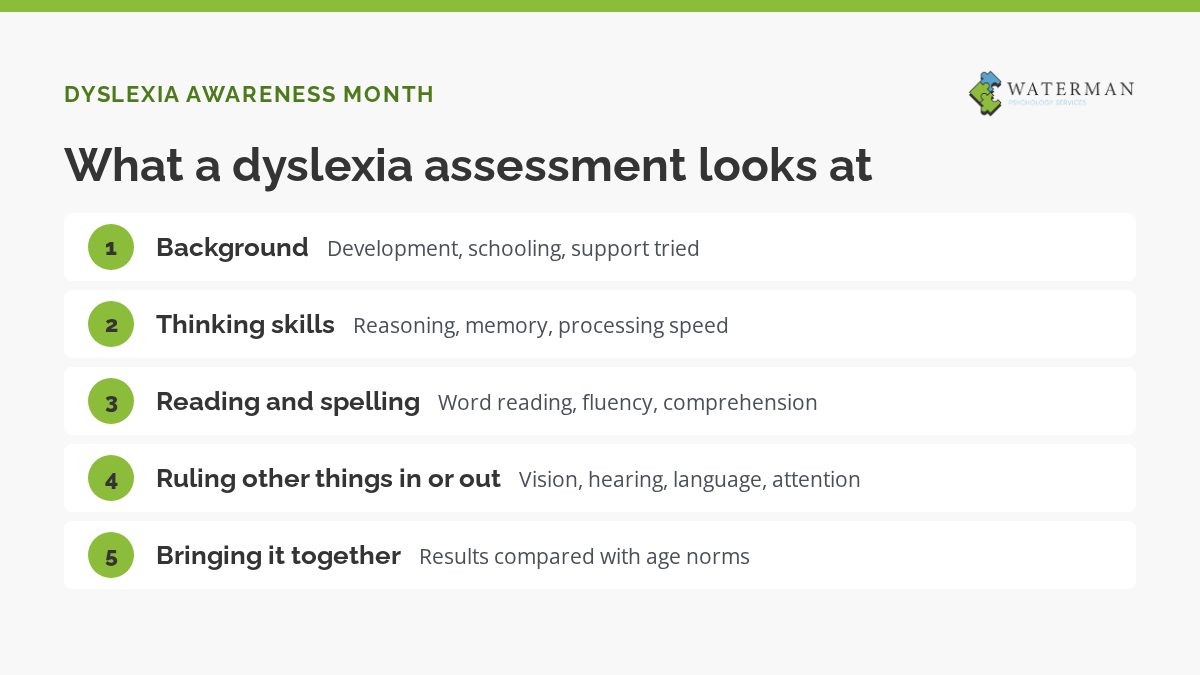
The assessment brings together five things:
- Background. Your child’s development, schooling, what support has been tried and for how long, and reports from health professionals from about the last two years.
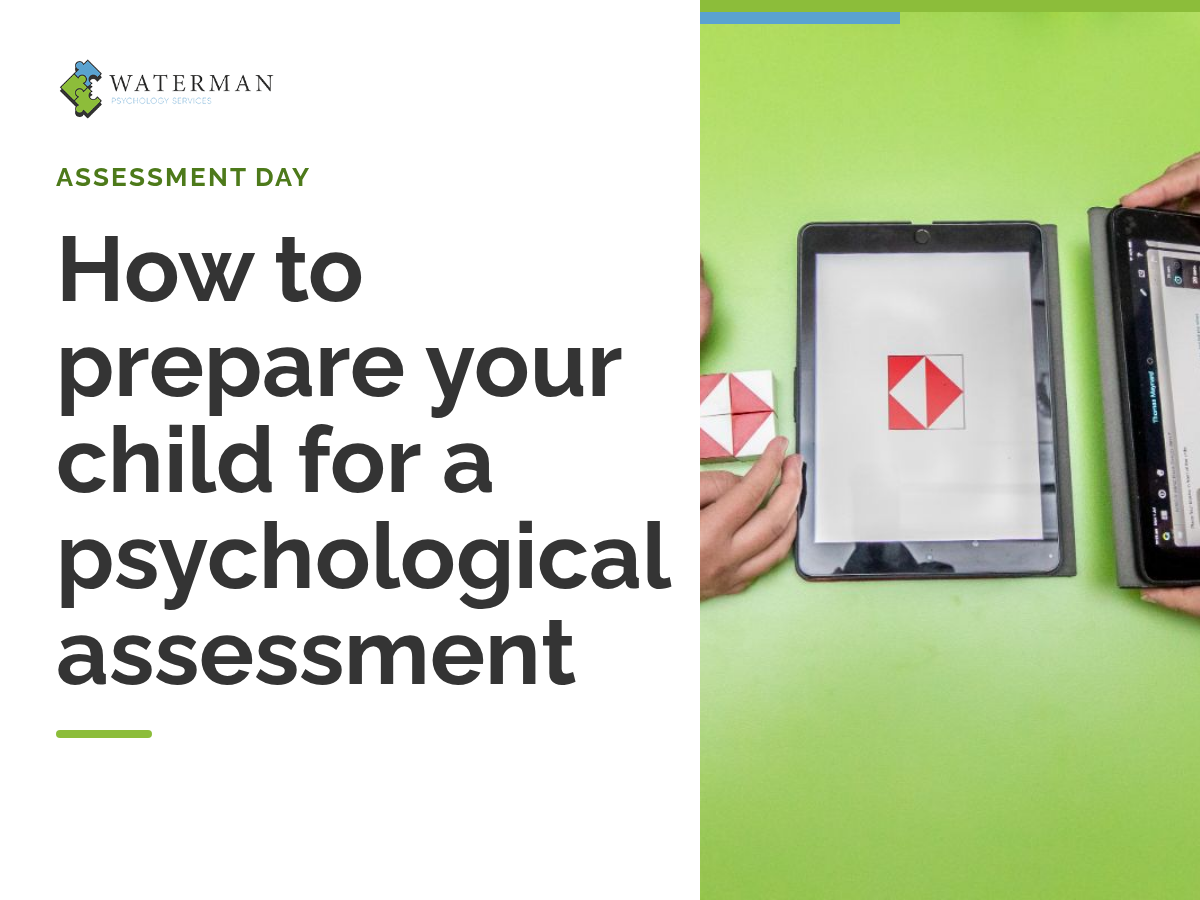
- Thinking skills. A standardised cognitive assessment of reasoning, memory and processing speed. Much of the testing is done on an iPad.
- Reading and spelling skills. Standardised tests assessing familiar word reading, sounding out unfamiliar words, reading speed and fluency, reading comprehension, spelling and written expression.
- Ruling other things in or out. Whether something else explains the difficulties, such as vision or hearing problems, language difficulties, attention difficulties or limited reading instruction.
- Bringing it together. Comparing the results with age norms and the diagnostic criteria, then explaining what they mean for your child.
In plain terms, the criteria look for reading difficulties that have lasted at least 6 months despite targeted help, that are well below what’s expected for your child’s age and get in the way at school, that started during the school years, and that aren’t better explained by something else, such as intellectual disability or vision or hearing problems (American Psychiatric Association, 2022).
What age can a child be tested for dyslexia?
We assess children from age 6. Many children are assessed between about 7 and 10, once they’ve had a couple of years of reading instruction and the school can see whether extra help is making a difference. If your child is under 6, we suggest talking with your GP or a paediatrician first.
Can school screeners or online tests diagnose dyslexia?
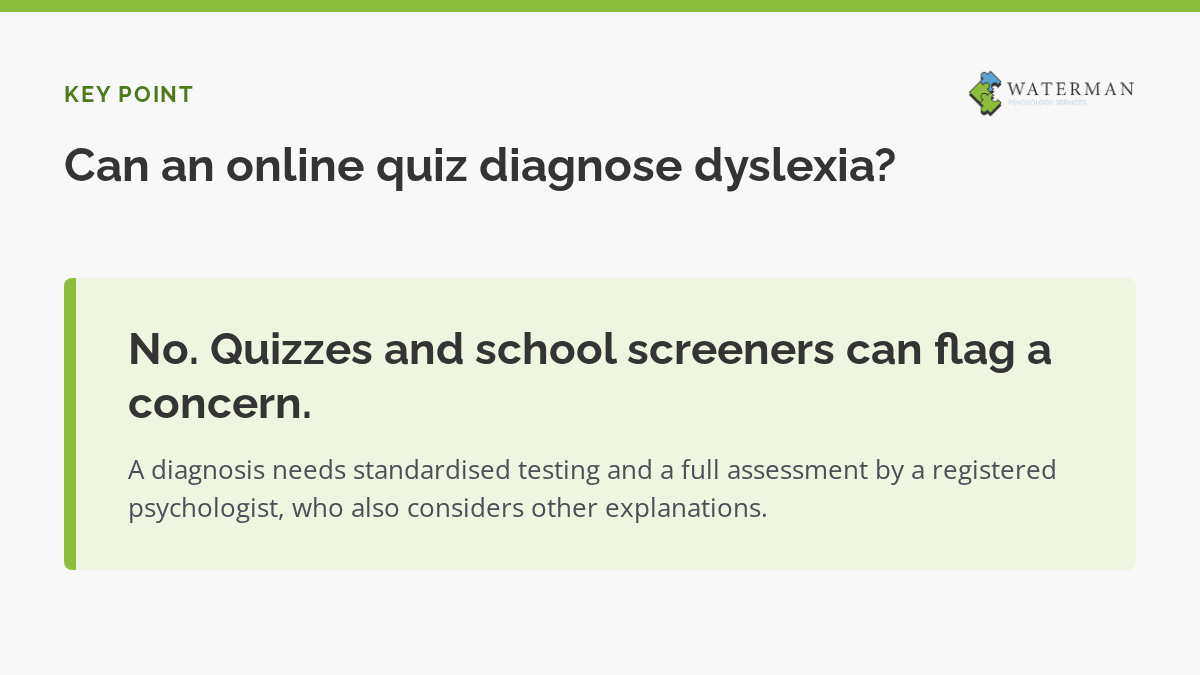
No. School screeners, such as the Year 1 Phonics Screening Check used in South Australian public schools, and online checklists can show that a child may be struggling with reading. They’re useful early warning signs. A diagnosis needs a full assessment that considers other explanations.
If a screener or a teacher has raised a concern, that’s a good time to talk with the school about what support they can offer, and whether an assessment would help.
Can adults be tested for dyslexia?
Yes. Many of the adults we see are in their early 20s and at uni, wanting to understand difficulties they’ve had for years, or to support an application for study adjustments. Universities set their own rules for adjustments, so check with your uni’s disability or access service about what they need. An adult educational assessment at Waterman is $1,700.
How much does a dyslexia assessment cost?
At Waterman, a child educational assessment, which includes assessing for dyslexia, is $1,595, with a $550 non-refundable deposit at booking. If attention is also a concern, a combined educational and ADHD assessment is $1,795. Medicare doesn’t cover educational assessments. Private health may cover it, so check with your health fund to see if yours covers psychological assessments.
Fees are current as at October 2026. See our fees page for the latest prices.
What happens after the assessment?
You’ll get a written report, written by your psychologist, not AI. It explains what the testing found and sets out recommendations for home and school. You can share it with your child’s school, GP, paediatrician or speech pathologist. Schools decide on any adjustments or extra support, and a clear report gives them something specific to work from.
For children with reading difficulties, research supports explicit, systematic teaching of phonics and other reading skills (Rowe, 2005). The report will point to the kind of support that fits your child’s results.
Questions parents often ask
Do I need a referral?
You don’t need a referral to book an educational assessment with us. You can book online or call 08 8133 5711.
What should we bring?
Reports from health professionals from about the last two years, such as speech pathologists, occupational therapists, psychologists or paediatricians. You don’t need every school report. If we need anything from the school, we’ll ask.
Can you test for dyslexia and ADHD at the same time?
Yes. A combined educational and ADHD assessment covers both in one 3-hour appointment, for $1,795. Our guide to which assessment your child needs can help you decide.
How long is the wait?
The current wait is about 4 weeks.
Booking a dyslexia assessment at Waterman Psychology
Every assessment at Waterman Psychology is completed by a fully registered psychologist. We’re at 188 Glen Osmond Rd, Fullarton, open Monday to Friday, 10am to 5pm. Read more about our dyslexia assessments in Adelaide, book online or call 08 8133 5711.
If you or your child need urgent support, call 000, Lifeline on 13 11 14 or Kids Helpline on 1800 55 1800.
Reviewed by Michael Waterman, Registered Psychologist (MAPS), with over 17 years’ experience as a psychologist. AHPRA registration PSY0001318442. Last reviewed: 28/10/26
Sources
- American Psychiatric Association (2022). Diagnostic and Statistical Manual of Mental Disorders, Fifth Edition, Text Revision (DSM-5-TR).
- Rowe, K. (2005). Teaching Reading: Report and Recommendations. National Inquiry into the Teaching of Literacy. Canberra: Australian Government Department of Education, Science and Training.
- Department for Education, South Australia. Year 1 Phonics Screening Check.
Related reading: Which assessment does my child need? · How much does an ADHD assessment cost?
Read more about child educational assessments.